Lorena Sanchez-Gallastegui
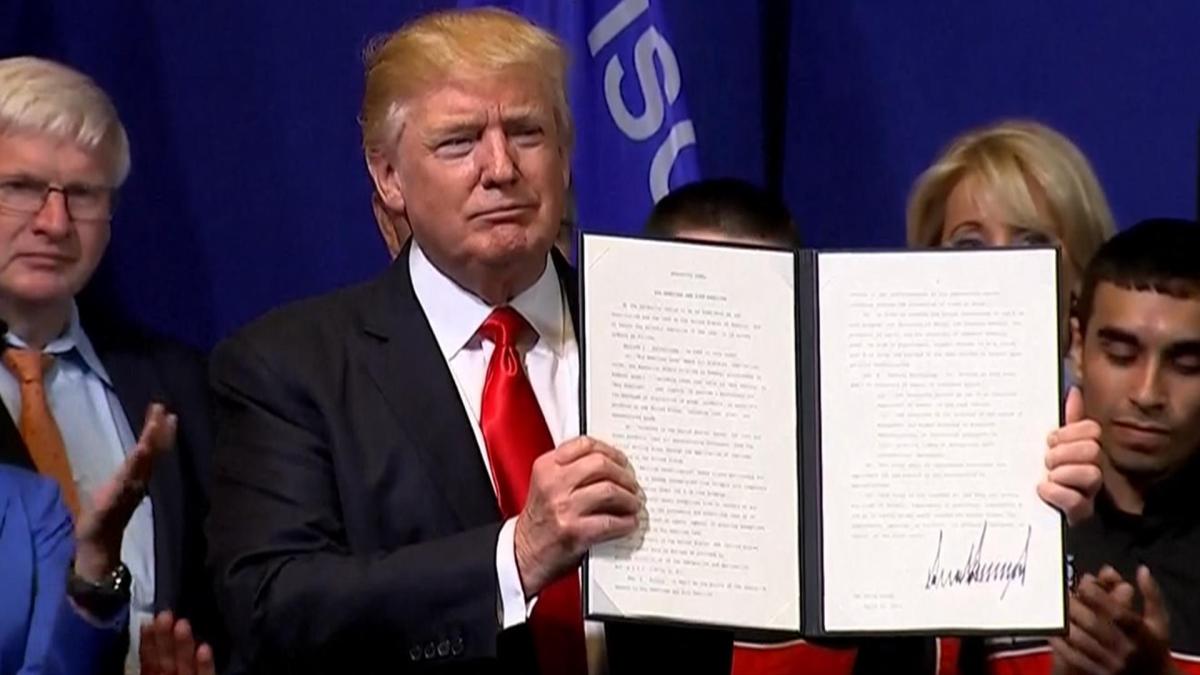
Executive Order (EO) 13788, otherwise called the “Buy American, Hire American” executive order, was signed by President Trump on April 18th, 2017. His goals with this ordinance were to foster prosperity for the American worker and to provide support for American manufacturing companies.
In reference to the “Buy American” portion of the executive order, Trump intends to implement a set of laws restricting ‘how good and manufactured products are obtained and how they’re used in federal projects or federally funded projects’. (NAFSA) In other words, this Executive Order is a “Buy American Law”. Like other rules and regulations falling into this category, the EO references the requirement or preference for goods, products and materials such as iron and steel to be produced in the United States in exchange for federal money or in federal projects. Besides the exchange between what goes on before production, this section of the EO more specifically targets the term ‘produced in the United States’. In terms of iron and steel products, this means all manufacturing process involved in creating the final product happened in the United States. From melting to coating, for the product to be considered ‘produced in the United States’ all processes need to have occurred in the United States. Suppose the state of Georgia wanted to build a bridge, this new ordinance will effect the product and said process substantially. The bridge would have to be built with American steel in order for the federal government to fund it thus stimulating the economy before said bridge was even built.
In retrospect, the ‘Buy American’ ordinance of EO 13788 would ‘stimulate’ economic growth and ‘promote’ national security of the United States. (whitehouse.gov) By solely relying on the resources provided by American manufacturing companies, the economy is supporting itself from within. Idealistically, the American economy would be weaning itself off dependency of other countries goods and services. However, because of the decrease in foreign competition, prices of resources could substantially increase within the US. Under the concept of monopolistic competition, American producers of iron and steel would find themselves with more power over the distribution of manufactured metals than they had before. This would give the firms the ability to raise prices amongst themselves whereas before, they had a wider platform for competition and had to take into account more firms so as to not affect the quantity demanded of their product. Additionally, the lack of trade between foreign countries could hurt international relations with decreasing trade and the exponential increase of taxes. With a decrease in flow of goods between countries, other imported goods would become more expensive or become more heavily taxed due to the shortcoming that the EO would cause.
People are often turned away from jobs because they are not qualified enough. Now companies are turning people away, not because they are under-qualified in their prospective skills, but because they are not American and therefore do not qualify. The ‘Hire American’ part of Executive Order 13788 is based upon creating ‘prosperity’ among the ‘blue collars’ of America by creating new jobs and decreasing the unemployment problem among Americans. For years the debate of whether or not immigrants are ‘stealing American jobs’ has raged on without the consideration that perhaps said immigrants are more qualified to do the job at question. On the more negative side of business, sometimes firms will use this program for cheaper labor and partake in practices that are considered ‘discriminatory’ to American workers as defined by the US Department of Justice. With the explicit statutes as defined by the EO, out sourcing becomes more difficult for firms and therefore their production costs may increase. Protecting against the business practices that advocate for cheaper labor rather than American prosperity, there is the anti-discrimination provision of the Immigration and Nationality Act which prohibits the discrimination of American workers in the process of hiring, firing or recruiting.
Many times, working people come to the US on an H1-B Visa which is a working program that requires petition by the employer, extensive qualification of the employee and acceptance of the government before the visa is given. This process, as discussed in another blog post, is difficult enough as it is. However, with the EO calling for a significant decrease in available visas, the application process suddenly becomes that much more competitive. More barriers are being put in place to prevent larger corporations from using cheaper labor but there are a few specialty job positions which may be forced to consider weaker candidates due to said barriers.
Executive Order 13788 is beneficial in terms of redefining the use of the H1-B Visa program by employers to avoid fraud and abuse of the program in the hiring process of companies. However, it may leave some high skill and specialty spots with less qualified people if a better candidate is a foreigner with a denied visa. The ‘Buy American’ part of the EO will hurt individual companies and international relationships as it will increase production costs, tariffs and decrease trade with other nations. On another hand, it may give American iron and steel manufacturing companies more business and therefore benefit to the American economy. Overall, the Executive Order can do as much harm as it can benefit and only time will tell whether the new policies will contribute to “American prosperity” as described in an NBC newscast in relation to the EO.
 Immigration and Economics