Lorena Sanchez-Gallastegui
Immigrants have always held a significant contribution to the United States economy, today as political candidates address the issue of immigration policy; we pay more and more attention to those people and how they are affecting our own jobs and economic prosperity. An increase in efforts to legalize the millions living undocumented could create opportunity for not only the individual but for the economy and the native-born workers around them.
In today’s political climate, the topic of immigration is one that is commonly discussed. Whether the conversation be about policies surrounding the process of acquiring a green card, a visa or citizenship or whether it be about the immigrants themselves and what they are contributing to the country as a whole; Americans commonly take a bipartisan stance with little knowledge or consideration for individual situations. Most recently, we witnessed Donald Trump’s presidential campaign where he promised to “Make America Great Again”. In 2015, Trump voiced his belief that immigrants are ‘taking our jobs’, ‘taking our manufacturing jobs’, taking our money’ and ‘killing us’. All of these beliefs were the motivation behind his ‘proposed policies’ of building a wall on the US-Mexico border, enact stricter deportation policies and have more border patrol agents. Frankly, immigrants, in President Trump’s eyes, are negatively affecting the job market and effectively harming American opportunities.
In the 2017 Current Population Survey(CPS), we find that 27% of the country’s 321.1 million people are immigrants or first-generation US born children to immigrant parents. In 2016 alone 1.49 million immigrants entered the United States or ‘foreign born individuals’ as Jie Zong, Jeanne Batalova and Jeffery Haddock refer to them in “Frequently Requested Statistics on Immigrants and Immigration in the United States”. Surprisingly, the leading country of origin was India, not Mexico as we have all been led to believe by mainstream media. However, Mexican immigrants as a whole make up 26% of the immigrant populations. Additionally, Mexico is the leading country of origin of illegal ‘aliens’ entering the United States; a nation with an estimated 12.1 million undocumented peoples living within its borders.
Illegal ‘aliens’ is a term given to those who have entered the country undocumented, meaning they did not have a visa to enter the country and are not lawfully residing within the country; other terms may include unauthorized immigrant, illegal immigrant or undocumented worker. They work and contribute to the American economy and American society. After all, ‘college graduates are more prevalent among recent immigrant adults than among all adults in 90 of the 100 largest metropolitan areas’ according to William Frey, Senior Brookings Fellow. Their children go to school alongside American children. Some have family and some are by themselves. With such variety and so many different situations, it seems wrong to marginalize all of these people into one narrow idea of the ‘illegal immigrant’ without the consideration of individual factors.
As an attempt to legalization, President Obama’s administration created the Deferred Action for Childhood Arrivals (DACA) program in 2012. This program granted protection from deportation and gave legal work authorization to individuals who ‘came to the United States as children, have pursued an education and neither pose a national security threat nor have committed serious crimes’(Hipsman,Meissner). In the time between the past presidency and current the economy saw growth in the GDP as high as 5.1% due to increases in innovation, workforce and investment. However, the program came under fire when Donald Trump took office and is now under review.
In 1986, The United States legalized a ‘significant percentage of the undocumented population’ with the Immigration Reform and Control Act (IRCA) of 1986. Throughout the years, researchers have found that IRCA provided ‘unexpected indirect benefits’ to the communities of legalized immigrants. For example, Hugo Ortega, who became the owner of a top restaurant in Houston, created jobs and hired U.S workers within his community with the restaurant.
According to Brookings Senior Fellow Dany Bahar, immigrants represent 15% of the general American workforce but account for approximately a quarter of entrepreneurs within the US and a quarter of investors in the US. This is effectively a positive link between immigration and economic growth thus rendering President Trump’s quick judgment counterproductive to an economy in which he is a knowledgeable billionaire. Although there is the argument of immigrants negatively impacting native-born workers, Bahar argues that the negative impacts ‘occur for the most part on wages of prior immigrants with similar skillsets’.
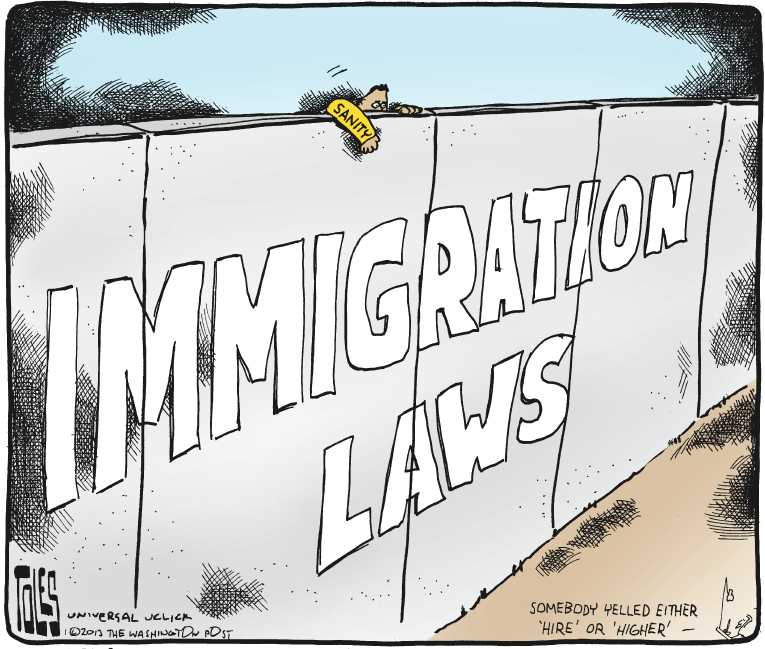
Enforcement of immigration laws could be costlier than legalization. The burden of covering the costs that federal funding cannot falls on the local taxpayers as it happened in Harris County, Texas in February of 2017 when their agreement with ICE ended due to the biweekly $1 million in overtime costs they were paying for increased enforcement. Other places such as Alamance County, who is considering rejoining the Delegation of Immigration Program (278(g)), has built a $12 million jail expansion to ‘accommodate for the growth’ as a The Hill article stated. And these are just economic statistics, the social costs become greater. In a survey within Davidson County, Tennessee, a former ‘partner’ of the 287(g) program, it was found that 54% of Latinos did not report crime and 73% cooperated with police with apprehension. There is an unspoken human right to feel protected, to have a safe environment where we can thrive as human beings however, the world around us is doing a poor job of upholding that.
There are far too many too ignore and far too many possibilities to dismiss the issue. The costs will outweigh the benefits in the sense that by making efforts to legalize the undocumented people who are bettering our country, who are working in our fields and bettering society with increased education rates. Legalization will provide them with opportunities that could potentially create opportunities for the American people and further more the possibility of expanding the economy with investment and innovation that may have never otherwise reached the market.
(IMAGE)
 Immigration and Economics